
How Remote Physical Therapy beneficial for Patient Recovery?
- vitalwatch33
- Dec 15, 2025
- 6 min read

Updated: Dec 16, 2025

Remote Physical Therapy, sometimes shortened to remote PT or pt remote, has become one of the biggest shifts in how people recover today. Not because it’s trendy, and not because clinics are going away. It’s growing because people are realizing something simple: most recovery happens at home anyway. And a therapy treatment plan only works if the person can actually follow it consistently.
Remote PT makes that easier. No travel, no waiting rooms, no rescheduling, no juggling time off work, no worrying about how many sessions insurance will cover. You just follow the plan where you’re most comfortable, your home and get guidance that helps you stay on track.
Let’s walk through how remote physical therapy actually works, why it helps people recover faster, and what makes it surprisingly effective.
Why Remote PT Works Better for Many People
Remote PT works because it solves problems patients have struggled with for years: missing appointments, inconsistent routines, pain flare-ups on “off days,” feeling embarrassed doing exercises in a clinic, or simply not having time.
You remove those barriers, and suddenly people stick with therapy longer. And when people stick with therapy longer, they recover better.
Below are the core reasons remote PT helps improve outcomes.
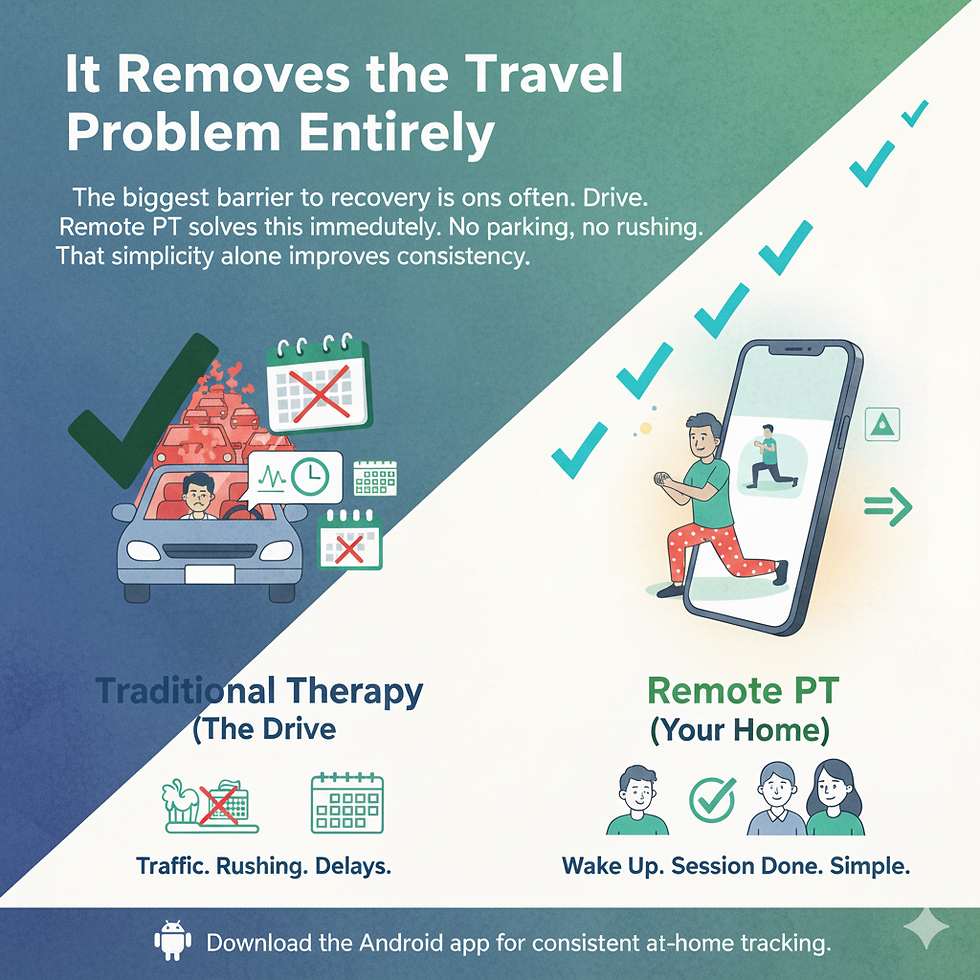
1. It Removes the Travel Problem entirely
For many patients, the biggest barrier to recovery isn’t the exercise, it’s the drive. Chronic pain, busy schedules, mobility issues, or distance from clinics can turn a simple session into a full half-day commitment. Remote PT solves this immediately.
You wake up, start your session, and you’re done. No parking, no traffic, no rushing.
That simplicity alone improves consistency.
2. Recovery Happens Where You Actually Live
This sounds small, but it matters a lot. Doing exercises in a clinic is one thing. Doing them in your actual home environment is another, your flooring, your lighting, your furniture, your daily setup.
Remote PT makes your therapy routine part of your everyday life, not a separate event. The movements become more natural. The repetition is easier. You feel less pressure and more control.
For a therapy treatment plan, that’s gold. Login for free and see how simple recovery can be.

3. Real-Time Feedback Helps Prevent Mistakes
Many injuries linger because patients unknowingly do exercises incorrectly, wrong angle, bad posture, uneven weight distribution, or too much pressure on one joint.
Remote PT systems (especially those using AI-driven motion tracking) give real-time corrections. They catch mistakes the moment they happen.
“Lift a little higher.” “Straighten the spine.” “Slow down this movement.” “Shift weight evenly.”
It’s like having a therapist watching every rep, but without the scheduling limitations.

4. More Frequent, Smaller Sessions = Faster Results
Traditional therapy usually happens once or twice a week. But healing doesn’t work in weekly chunks. Muscles and joints respond better to frequent, shorter, controlled movement.
Remote PT makes this possible.
You can do your 15-minute or 20-minute guided sessions daily or even twice a day if needed. The repetition builds strength, flexibility, and endurance faster than large gaps between appointments.
Think of it like brushing your teeth. Once a week wouldn’t work. Same idea here. The daily exercise oversight that used to rely solely on therapists can now be automated, especially as more people begin to download the android app and use it for consistent at-home tracking.

5. Better Tracking for Better Adjustments
One of the biggest advantages of remote PT is data, the system doesn’t guess, it records.
It tracks:
Mobility improvement
Range of motion
Balance changes
Repetition quality
Progress speed
Pain markers
Exercise completion consistency
This gives you and your care team, clear insight into how you’re progressing. If something needs to change, it changes quickly. No waiting for your “next appointment.”
Better data means a better treatment plan.

6. Builds Confidence During Recovery
Many patients admit they feel anxious doing therapy in a clinic, afraid they’re “doing it wrong” or not improving fast enough. At home, that pressure goes away.
Remote PT:
Gives you privacy
Removes performance pressure
Lets you learn at your own pace
Makes you more likely to complete each session
Confidence is a serious part of healing, even if we don’t talk about it often. When patients feel more comfortable, they push a bit more, stay consistent, and stay motivated. Recovery will become preventative rather than reactive, especially as more people begin to download the iOS app and use these tools at home.
7. Fits Modern Life Instead of Interrupting It
Not everyone can leave work early. Not everyone has childcare. Not everyone can drive 3x a week.
Remote PT adapts to life, not the other way around.
Morning session? Fine. Night session? Also fine. Weekend? Perfect. Traveling? Still possible.
This flexibility keeps people moving forward even when life gets messy.
8. Encourages Long-Term Recovery Instead of Quick Fixes
Most therapy plans are 4–12 weeks long. But many people need longer-term maintenance, especially for:
Chronic lower back pain
Post-surgical recovery
Arthritis
Joint stabilizing work
Muscle imbalance
Mobility upkeep
Remote PT makes extended rehab feel less tiring and more natural to continue. It doesn’t feel like “going to therapy”- it feels like building a consistent habit.
That’s why results last longer.
How Remote PT Works Step-by-Step
Here’s the simple flow:
1. You get your personalized therapy treatment plan
Based on your condition, surgery, injury, or mobility needs.
2. You log in from your phone or smart device
No special tech skills required.
3. The system guides you through each exercise
With clear instructions, demonstrations, and real-time corrections.
4. You complete the routine at your own pace
No rush, no judgment.
5. All your movement is tracked automatically
The system measures performance, form, and improvement.
6. Your plan adjusts as you get stronger
Progress happens naturally because the program fine-tunes itself to fit your improvement.
7. You repeat the cycle consistently
That consistency is where real healing happens.
Who Benefits Most from Remote PT?
Remote PT works extremely well for:
Post-surgery recovery (knee, hip, shoulder)
Back and neck pain
Stroke or neurological mobility support
Arthritis symptoms
Balance and fall-prevention
Sports injury recovery
Seniors needing daily movement coaching
People with packed schedules
It’s especially helpful for anyone who struggles with keeping appointments or needs guidance more frequently than a clinic can realistically offer.
Comparison: Remote PT vs In-Clinic PT
Below is a simple, grounded comparison, not to say one is “better,” but to show how they differ.
Feature | Remote Physical Therapy | Traditional In-Person PT |
Access | Anytime, anywhere | Fixed appointment times |
Guidance | Real-time digital feedback | Therapist observation |
Convenience | No travel, no waiting | Requires travel |
Privacy | High | Low to medium |
Cost | Usually lower | Higher session fees |
Consistency | Daily or frequent sessions | 1–2 sessions/week |
Data Tracking | Automatic + detailed | Manual notes |
Hands-On Techniques | Not included | Available |
Final Thoughts- And Why VitalWatch365 Is Leading This Space
Remote Physical Therapy is no longer an experiment. It’s a practical, accessible, and often faster way for people to recover at home. When real-time guidance, adaptive plans, and motion tracking come together, it becomes easier to stick with your routine, and that’s the key to healing.
If you’re ready to try a system built for real people, not just tech-savvy ones, VitalWatch365 offers one of the most advanced remote PT experiences out there. Their platform uses AI-driven motion analysis, progress tracking, adaptive therapy treatment plans, and easy-to-use tools that help patients recover confidently at home, without the stress of appointments or travel.
Whether you’re recovering from injury, surgery, or long-term pain, VitalWatch365 can guide you step by step. It’s simple, it works, and it fits into real life.
Frequently Asked Questions
Q: Is remote PT actually effective?
Yes, when followed consistently, it often matches or surpasses clinic-based progress because patients do more repetitions with fewer barriers.
Q: Do I need equipment?
Most programs require only body weight. Occasionally small tools like resistance bands, but nothing complex.
Q: Is it safe for seniors?
Yes, many seniors find remote PT easier because they don’t have to travel.
Q: Will my plan be personalized?
Good platforms adjust your exercises automatically based on your performance, not generic routines.
Q: What if I’m not good with technology?
Remote PT tools are usually simple, open the app, follow the guide, and the system does the tracking for you.


Comments